
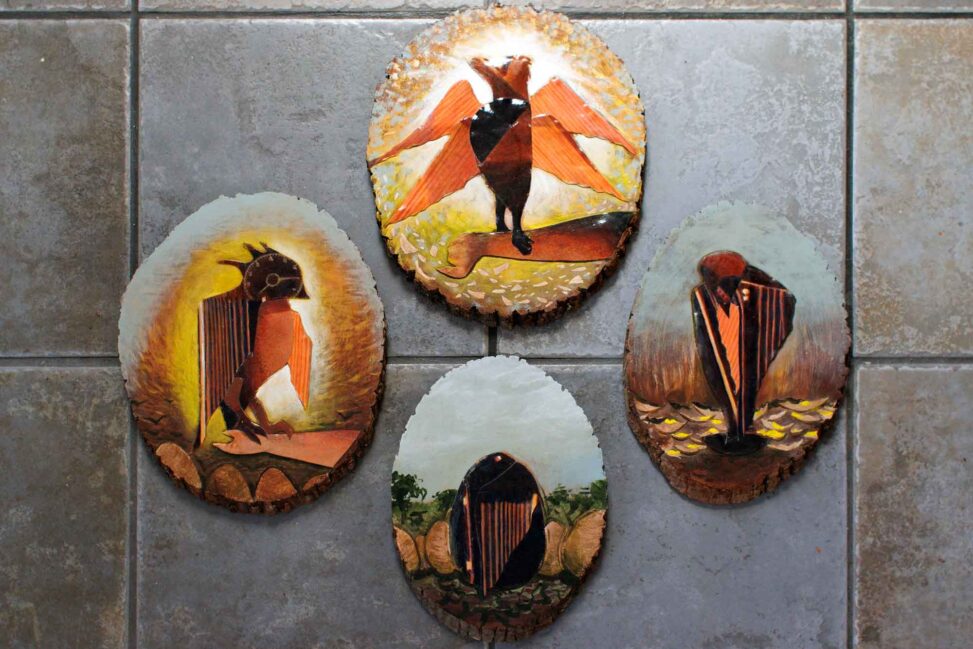
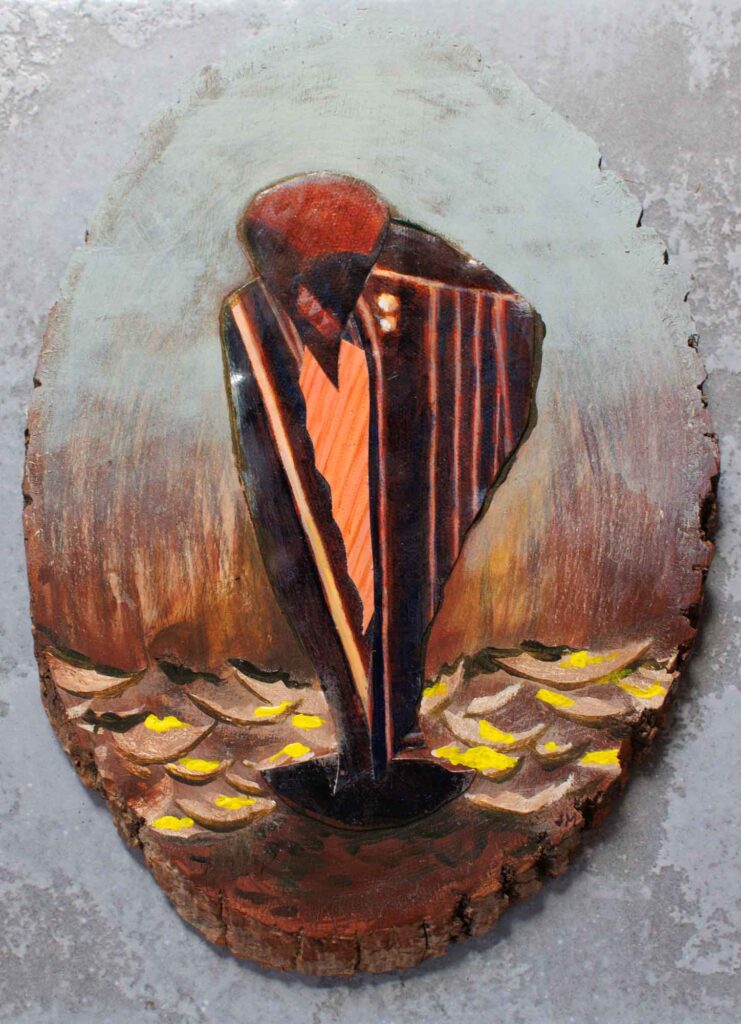
DECONSTRUCTED CANVAS AND ACRYLIC ON WOOD • 4 pieces, approx. 12″ x 10″ each
$375 for the set • Email julie@juliemeridian.com to buy this artwork ⇢
This one has been brewing for over a year, and is neither a beginning nor an end but a marker in time.
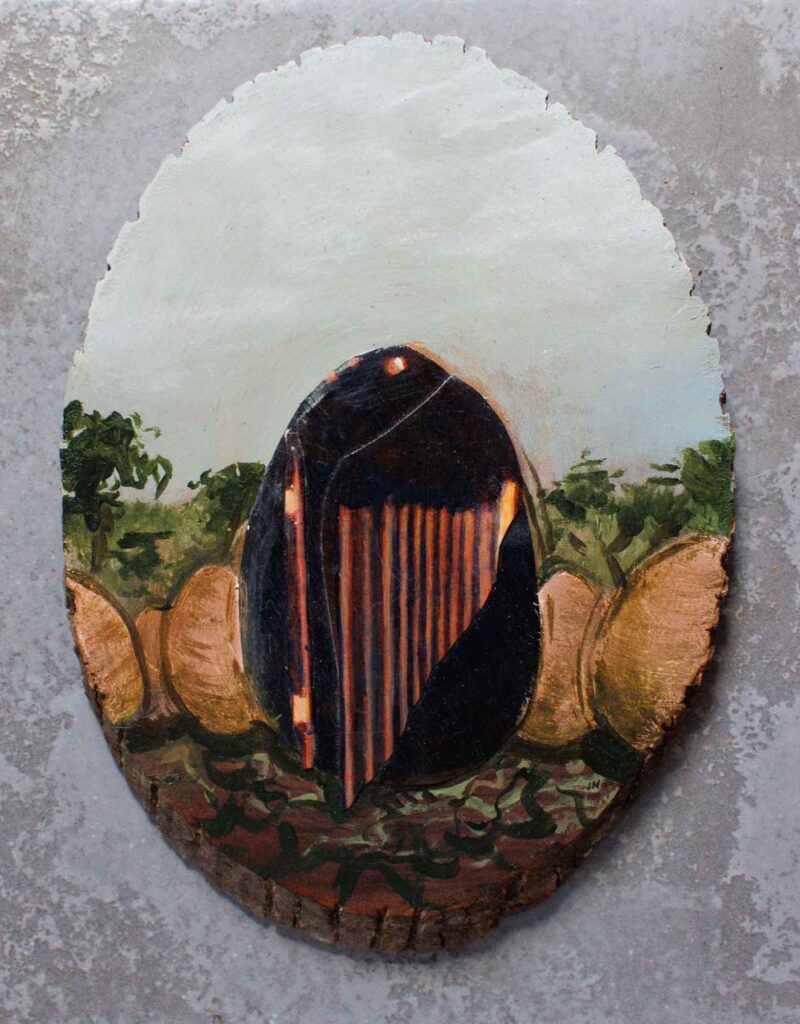
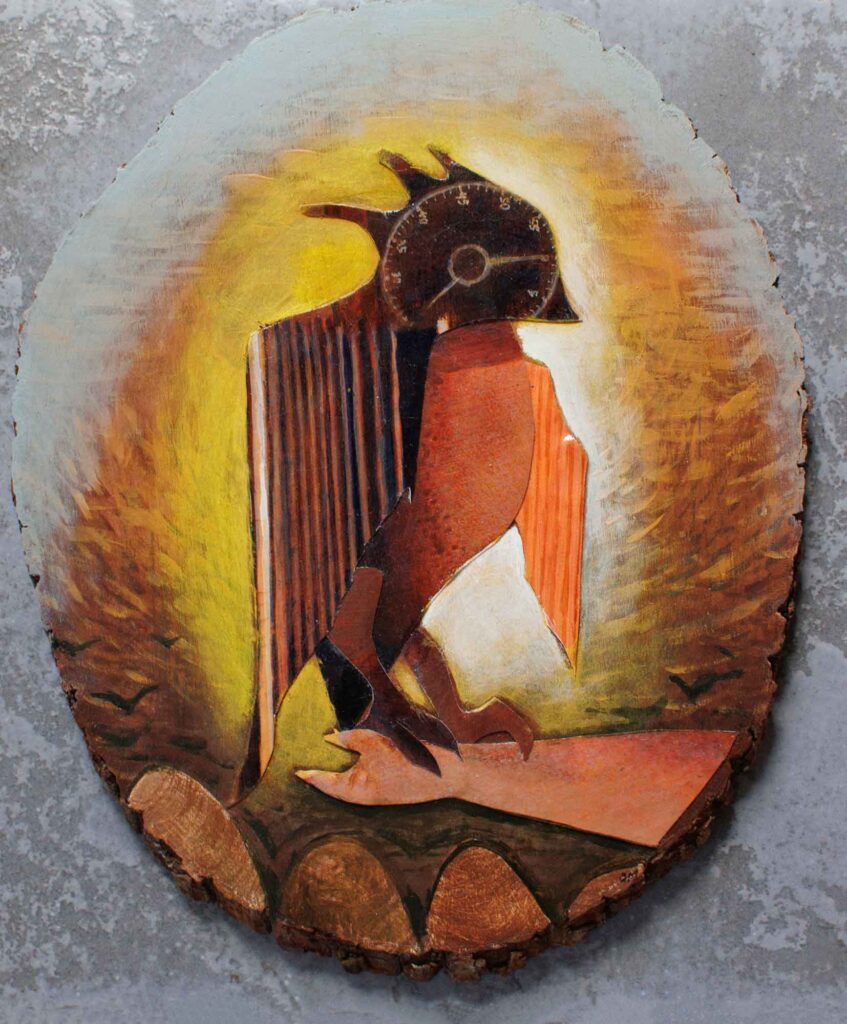
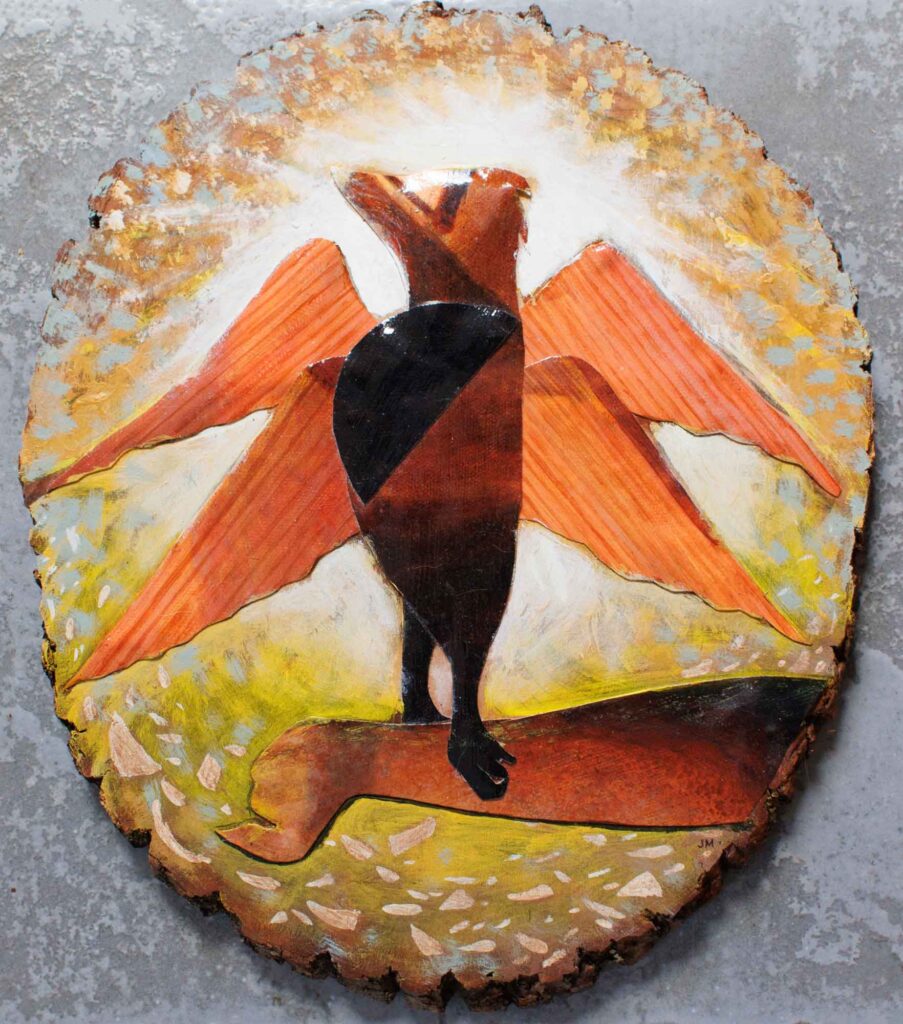
This set is how I imagine the progression for an artificial phoenix. Like any artificial thing, it can “live” as long as it is imbued with meaning, and it can co-exist in harmony as long as the natural system can continue. If it’s propped up too much, and intermingled too far, it may temporarily outshine it but ultimately destroy what is around it.
Background
After a big art show, I typically have a lull of a few months afterward until I start gearing up for a fresh series. Once I’m ready to line up a show, that planning happens a year or more before the show itself. It’s a cycle of about two years that I’ve gone through five times. The last show I had was early 2024 where the primary theme was about grappling with visual generative AI.
Just around the time I was starting emerge from that post-show lull, a work opportunity emerged for shaping how generative AI was applied at a company with a stance I respected (language only, for conversation) – so I took it. I could see this wasn’t a temporary FOMO panic like NFTs but a more profound shift, similar to the web or smartphones/mobile apps. As much as I’d prefer to be a conscientious objector, it could not be ignored. I’ve felt a strong obligation to do what I could, with the knowledge and career I’ve had, to try to bend that arc towards more humane use.
What has been true for artists continues to be a fundamental challenge: across the board, greed and magical thinking created a profoundly hostile environment for the value of creative work that has not yet recovered. The Concept Art Association, Fairly Trained, and artists like Dave McKean were beacons to me in clearly and patiently showing a path for fair data use and tech that could genuinely benefit creative pros. In its best form, this particular tech could meet people where they are at, and streamline some of interim aspects of execution between intent and outcome. What is can be is not inevitable.
Creating this set
All of this is why progressive decay has been an ongoing theme for me. Last year I created a half-dozen+ paintings of mushrooms while thinking about the rebirth aspects of decomposition. They’re a quiet part of a healthy system that breaks down and reworks resources into other forms. With AI, what I see now is both promise but also an unhealthy imbalance. I know over time that cannot hold.
I’ve also been reclaiming some of my own materials, partly to purge what I no longer want to hold, and partly to process the challenges of now. I’d deconstructed a painting that served its purpose but had bothered me from a materials perspective: the sealant I’d used remained a touch tacky and shiny, and I wondered what else I could do with it. I pulled it off the stretcher bars and got the idea of reworking its warm colors into a collage of a phoenix.
I put together the shapes and progression of the phoenix, and the human arm propping it up, relatively quickly. Figuring out the environment and story around it took much longer. I grappled with which materials to use, especially whether to preserve the wood texture. I got stuck on using charcoal as a rather literal interpretation of the phoenix burning the wood, but it ended up gloomy, muddy, and looking unfinished.
After months of repeated cycles of looking at these, putting them away, and bringing them back out, I realized there needed to be more signals of its “life” in the 2nd and 3rd pieces so I painted in a somewhat obnoxious yellow glow. That was enough to motivate me to add a blue-ish sky to the 1st and 4th ones, and think a little more about the nest that these needed as well.
I went on a brief side track thinking about mockingbirds dropping off their eggs in other birds’ nests, and that solved both the “what’s happening with the nests?” problem and introduced the narrative of the tech going too far if it’s too embedded. This idea felt appropriate for acknowledging the impact of generative art mimicry being snuck into the systems for artists to show their work (conventions, contests, etc). The scale and speed of these knockoffs quickly edged out artists and overwhelmed organizers, triggering a protective backlash that tainted the technology and has set back anyone exploring it in good faith. The good faith artists are seeing it as a kind of medium to explore in all its weirdness and adjacencies to other technologies.
In all of this, I feel pretty bad for the digital artists who translated their mark-marking from analog tools – the creative professionals I got to know as users when I led design for Photoshop and Illustrator. In a deeply unfair twist, these digital-only artists now have a higher burden of proof about what they do than if they hadn’t made the switch at all.
So there’s a lot behind this set for me, and I’m looking forward to other (lighter) projects. One quality I do enjoy about it is that since it’s a set of 4, there are a lot of ways to lay it out that make sense. Here’s all the variants I came up with.


Leave a Reply